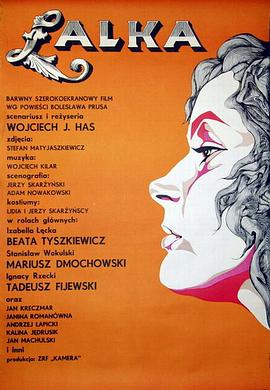
玩偶1968
788
7.0
HD中字
玩偶1968
7.0
更新时间:03月26日
主演:马里乌什·德莫霍夫斯基,贝娅塔·蒂希基维茨,菲耶夫斯基·塔德乌什,Jadwiga Gall,维斯拉夫·格拉斯,卡里娜·谢鲁斯克,Jan Koecher,扬·克雷奇马尔,塔德乌什·孔德拉特,Halina Kwiatkowska,安杰伊·瓦皮茨基,扬·马休斯基,Józef Pieracki,Janina Romanówna,Anna Seniuk,Irena Szramowska,Wladyslaw Dewoyno,卢德维克·伯努瓦,克雷斯蒂娜.费尔德曼,Aleksander Fogiel,Andrzej H
简介:

  The Doll is an adaptation of the novel, The Doll (novel) by Bolesław Prus, which is regarded by many as one of the finest Polish novels ever written and, along with Pharaoh (novel), made Bolesław Prus a potential candidate for the Nobel Prize in literature. The influence of Émile Zola is evident, and some have compared the novel to Madame Bovary by Gustave Flaubert; both were Prus's contemporaries. The movie, however, may be more compared to Stendhal's Le Rouge et le Noir, (The Red and the Black).
  The Doll constitutes a panorama of life in Warsaw between 1878 and 1879, and at the same time is a subtle story of three generations of Polish idealists, their psychological complications, their involvement in the history of the nineteenth century, social dramas, moral problems and the experience of tragic existence. At the same time this story describes the disintegration of social relationships and the growing separation of a society whose aristocratic elite spreads the models of vanity and idleness. In the bad air of a backward country, anti-Semitic ideas are born, valuable individuals meet obstacles on their way, and scoundrels are successful.
  This poetic love story follows a nouveau riche merchant, Stanislaw Wokulski, through a series of trials and tribulations occasioned by his obsessive passion for an aristocratic beauty, Izabela Lecka, played by the famous Polish actress, Beata Tyszkiewicz.
  Plot:
  As a descendant of an impoverished Polish noble family, young Wokulski is forced to work as a waiter at Hopfer's, a Warsaw restaurant, while dreaming of a life in science. After taking part in the failed 1863 Uprising against Tsarist Russia, he is sentenced to exile in Siberia. On eventual return to Warsaw, he becomes a salesman at Mincel's haberdashery. Marrying the late owner's widow (who eventually dies), he comes into money and uses it to set up a partnership with a Russian merchant he had met while in exile. The two merchants go to Bulgaria during the Russo-Turkish War of 1877-78, and Wokulski makes a fortune supplying the Russian Army. The enterprising Wokulski now proves a romantic at heart, falling in love with Izabela, daughter of the vacuous, bankrupt aristocrat, Tomasz Łęcki. In his quest to win Izabela, Wokulski begins frequenting theatres and aristocratic salons; and to help her financially distressed father, founds a company and sets the aristocrats up as shareholders in his business.The indolence of these aristocrats, who secure with their pensions, are too lazy to undertake new business risks, frustrates Wokulski. His ability to make money is respected but his lack of family and social rank is condescended to. Because of his "help" (in secret) to Izabela's impecunious but influential father, the girl becomes aware of his affection. In the end she consents to accept him, but without true devotion or love.(wikipedia)

2443
1968
玩偶1968
主演:马里乌什·德莫霍夫斯基,贝娅塔·蒂希基维茨,菲耶夫斯基·塔德乌什,Jadwiga Gall,维斯拉夫·格拉斯,卡里娜·谢鲁斯克,Jan Koecher,扬·克雷奇马尔,塔德乌什·孔德拉特,Halina Kwiatkowska,安杰伊·瓦皮茨基,扬·马休斯基,Józef Pieracki,Janina Romanówna,Anna Seniuk,Irena Szramowska,Wladyslaw Dewoyno,卢德维克·伯努瓦,克雷斯蒂娜.费尔德曼,Aleksander Fogiel,Andrzej H
坚不可摧(2018)
787
5.0
HD中字
坚不可摧(2018)
5.0
更新时间:03月26日
主演:安德烈·切尔内绍夫,弗拉基米尔·叶皮凡采夫,奥列格·福明,奥尔加·波戈迪纳,谢尔盖·格罗布琴科,尼古莱·多勃雷宁,瓦西里·谢迪赫,弗拉基米尔·科切特科夫,德米特里·佐洛图欣,Olga Aksenova,Maria Arnaut,Yuriy Balitskiy,Daniil Bogdanov,Oleg Chudnitsov,Anton Eskin,罗曼·迈迪安诺夫,瓦西里·史特帕诺夫
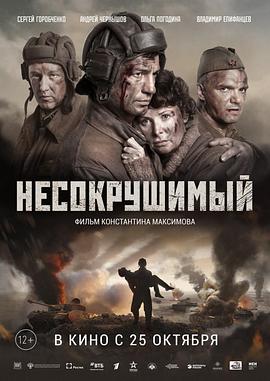
简介:  本片基于真实历史事件改编,讲述了第二次世界大战苏德战争期间KV-1坦克车组立下罕有卓越战功的故事。如果没有战争,谢缅·科诺瓦洛夫也许一辈子只是一名默默无名的基层军官,等着退役然后回到家乡平静生活。但在这场空前的大战中,他指挥的KB-1坦克车组在敌强我弱的悬殊对比下,消灭 德军16辆坦克,2 辆装甲车和8辆汽车,创造了战争史上以少胜多的又一奇迹。这个故事并非只是英雄的宣传画,更描绘了一群快乐、满身伤痕且性格迥异的年轻人在残酷战争中鲜活的形象。
105
2018
坚不可摧(2018)
主演:安德烈·切尔内绍夫,弗拉基米尔·叶皮凡采夫,奥列格·福明,奥尔加·波戈迪纳,谢尔盖·格罗布琴科,尼古莱·多勃雷宁,瓦西里·谢迪赫,弗拉基米尔·科切特科夫,德米特里·佐洛图欣,Olga Aksenova,Maria Arnaut,Yuriy Balitskiy,Daniil Bogdanov,Oleg Chudnitsov,Anton Eskin,罗曼·迈迪安诺夫,瓦西里·史特帕诺夫
欧洲的某个地方
787
9.0
HD中字
欧洲的某个地方
9.0
更新时间:03月26日
主演:Artúr Somlay,Miklós Gábor,Zsuzsa Bánki
简介:

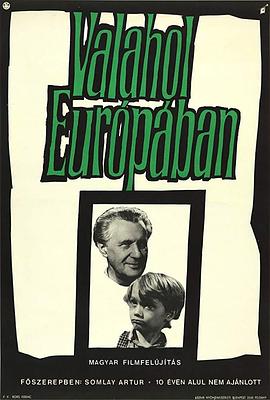
  Somewhere in the remote region, the war ends. In the midst of ruined cities and houses in the streets, in rural hamlets, everywhere where people still live, are children who have lost their homes and parents. Abandoned, hungry, and in rags, defenseless and humiliated, they wander through the world. Hunger drives them. Little streams of orphans merge into a river which rushes forward and submerges everything in its path. The children do not know any feeling; they know only the world of their enemies. They fight, steal, struggle for a mouthful of food, and violence is merely a means to get it. A gang led by Cahoun finds a refuge in an abandoned castle and encounters an old composer who has voluntarily retired into solitude from a world of hatred, treason, and crime. How can they find a common ground, how can they become mutual friends? The castle becomes their hiding place but possibly it will also be their first home which they may organize and must defend. But even for this, the price will be very high.
  To this simple story, the journalist, writer, poet, scriptwriter, movie director, and film theoretician Béla Balázs applied many years of experience. He and the director Géza Radványi created a work which opened a new postwar chapter in Hungarian film. Surprisingly, this film has not lost any of its impact over the years, especially on a profound philosophical level. That is to say, it is not merely a movie about war; it is not important in what location and in what period of time it takes place. It is a story outside of time about the joyless fate of children who pay dearly for the cruel war games of adults.
  At the time it was premiered, the movie was enthusiastically received by the critics. The main roles were taken by streetwise boys of a children's group who created their roles improvisationally in close contact with a few professional actors, and in the children's acting their own fresh experience of war's turmoil appears to be reflected. At the same time, their performance fits admirably into the mosaic of a very complex movie language. Balázs's influence revealed itself, above all, in the introductory sequences: an air raid on an amusement park, seen in a montage of dramatic situations evoking the last spasms of war, where, undoubtedly, we discern the influence of classical Soviet cinematography. Shooting, the boy's escape, the locomotive's wheels, the shadows of soldiers with submachine guns, the sound of a whistle—the images are linked together in abrupt sequences in which varying shots and expressive sharp sounds are emphasized. A perfectly planned screenplay avoided all elements of sentimentality, time-worn stereotypes of wronged children, romanticism and cheap simplification. The authors succeeded in bridging the perilous dramatic abyss of the metamorphosis of a children's community. Their telling of the story (the scene of pillaging, the assault on the castle, etc) independently introduced some neorealist elements which, at that time, were being propagated in Italy by De Sica, Rossellini, and other film artists. The rebukes of contemporary critics, who called attention to "formalism for its own sake" have been forgotten. The masterly art of cameraman Barnabás Hegyi gives vitality to the poetic images. His angle shots of the children, his composition of scenes in the castle interior, are a living document of the times, and underline the atmosphere and the characters of the protagonists. The success of the picture was also enhanced by the musical art of composer Dénes Buday who, in tense situations, inserted the theme of the Marseilaise into the movie's structure, as a motive of community unification, as an expression of friendship and the possibility of understanding.
  Valahol Europaban is the first significant postwar Hungarian film. It originated in a relaxed atmosphere, replete with joy and euphoria, and it includes these elements in order to demonstrate the strength of humanism, tolerance, and friendship. It represents a general condemnation of war anywhere in the world, in any form.

3744
1948
欧洲的某个地方
主演:Artúr Somlay,Miklós Gábor,Zsuzsa Bánki